
Steady Leadership in Unsteady Times
Can Leadership Stay Calm When the World Isn’t?
Right now, many leaders are carrying a quiet weight. With conflict and instability affecting several parts of the world, the question inside many organisations is the same..
"How do you keep people steady when the world itself feels unsteady?"
In recent weeks, companies like JPMorgan and Citigroup quietly asked employees in affected regions to work from home, with Citigroup saying simply, “We are continuing to take measures to help keep our employees and their families safe.” It is a small sentence, but it reflects a deeper shift in leadership.
Recent global workplace research tells a similar story. Around 40% of employees say they feel significant stress during the workday, a reflection of how uncertainty in the wider world is shaping how people feel at work.
In moments like this, the strongest organisations are not reacting loudly. They are doing something far more important. They are protecting their people first.
What many people do not see in moments like this is the quiet discipline behind those decisions.
Steady leadership rarely looks dramatic. It often appears as small, thoughtful actions that signal care and stability when the outside world feels unpredictable. Checking in on teams. Offering flexibility. Creating space for people to process what is happening beyond their work screens.
Because the truth is simple. People do not leave their humanity at the office door.
News travels fast. Families worry. Communities feel the ripple effects of global events. When uncertainty rises, employees carry those emotions with them into meetings, decisions, and conversations.
This is why the most resilient organisations follow a different order when responding to disruption.
First they stabilise their people.
Then they stabilise their operations.
Only after that do they focus on performance and recovery.
Many large global companies now design their crisis and continuity plans around this very principle. The assumption is clear. If people feel supported and safe, they can still think clearly, collaborate well, and make good decisions even in uncertain conditions.
Research consistently supports this approach. Employees who feel psychologically supported by their leaders are significantly more engaged and more likely to remain with their organisation during periods of disruption. In contrast, uncertainty without communication quickly erodes trust and productivity.
In other words, the strongest organisations understand something fundamental.
Stability is not created through policies or systems alone.
It is created through people.
And when leaders choose to protect their people first, they send a powerful signal across the entire organisation.
We will face uncertainty together.
We will move carefully.
And we will take care of each other along the way.
Because in the end, the real continuity plan in any organisation is human.
Why Human Moments Matter at Work
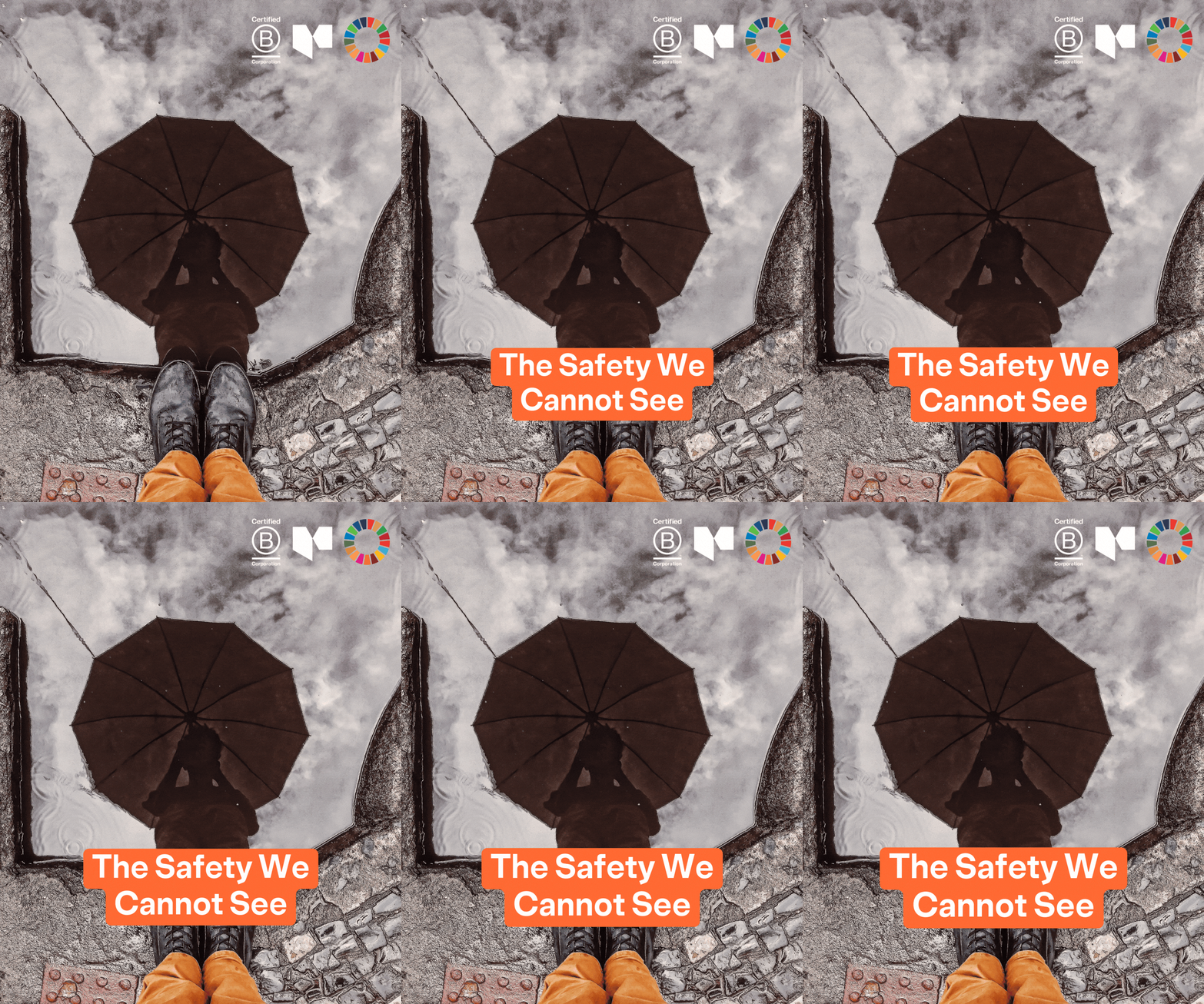
When we talk about safety at work, most people think about physical risk. Hard hats, compliance procedures, emergency plans. But one of the most important forms of safety today is something we cannot see. It lives in the small, everyday human moments inside organisations.
The moment someone feels safe enough to speak honestly. The moment a leader chooses calm instead of pressure. The moment a colleague notices someone struggling and pauses to check in.
Research from Google’s Project Aristotle found that psychological safety is the single most important factor behind high-performing teams. Because when people feel safe in these human moments, something powerful happens. They think clearer, collaborate better, and perform at their best.
The interesting thing about psychological safety is that it is rarely created through policies alone.
It is created through behaviour.
In how leaders respond when someone makes a mistake.
In whether questions are welcomed or quietly shut down.
In whether people feel heard when they speak.
Small responses shape culture.
Amy Edmondson, the Harvard researcher who pioneered the concept of psychological safety, explains that teams perform better when people believe they can share ideas, concerns, or errors without fear of embarrassment or punishment. In those environments, learning happens faster and problems are solved earlier.
And that matters because the opposite is also true.
When psychological safety disappears, people stop speaking up.
Concerns remain hidden.
Ideas stay unshared.
Mistakes go unreported until they become much larger problems.
Over time, the workplace becomes quieter, but not healthier.
This is why human moments matter so much.
The leader who pauses before reacting.
The colleague who asks a genuine question.
The manager who creates space for honest conversation.
These moments may seem small, but they shape how safe people feel every day.
And when people feel safe, something powerful happens.
They contribute more openly.
They support each other more naturally.
They bring their full thinking to the work in front of them.
In the end, psychological safety is not built through a single initiative.
It is built through hundreds of small human moments that tell people one simple thing.
You belong here.
Your voice matters.
And it is safe to speak.